

UEFA
Video Researches
Client – Nielsen Sports, Repucom, Sport+Markt
Industry – Sports Marketing Analytics
Project Type – Insights Videos & Multimedia Presentations
The Challange
For several years, we worked with sports marketing agencies SPORT + MARKT, Repucom and Nielsen Sports on a series of projects known internally as UEFA Video Research.
The agencies conducted extensive marketing research around major UEFA football tournaments, including the UEFA EURO, UEFA Women’s EURO, UEFA Futsal EURO and UEFA Youth Championships. Alongside the traditional research findings, presented through charts and written analysis, the projects introduced a more engaging way of understanding the data: in-depth insight videos built around interviews with fans and local residents, supported by detailed observational footage.
Our role was to turn the research into a complete multimedia experience. While the agencies were responsible for the research and its interpretation, we handled the production of all video content and the design and development of the multimedia presentations.
Rather than receiving a conventional report running to hundreds of pages, UEFA received an interactive presentation organised into thematic sections, with intuitive navigation allowing users to move quickly between different areas of the research. Each section combined research findings presented through carefully designed slides with a corresponding insight video, allowing users to move seamlessly from statistical data to real people, real opinions and visual evidence from the tournament environment.
„This multimedia presentation is absolutely fantastic. I would love for this to become our new benchmark going forward.”
Mark O’Keefe, UEFA Research Manager
Our Creative Approach – Video Production
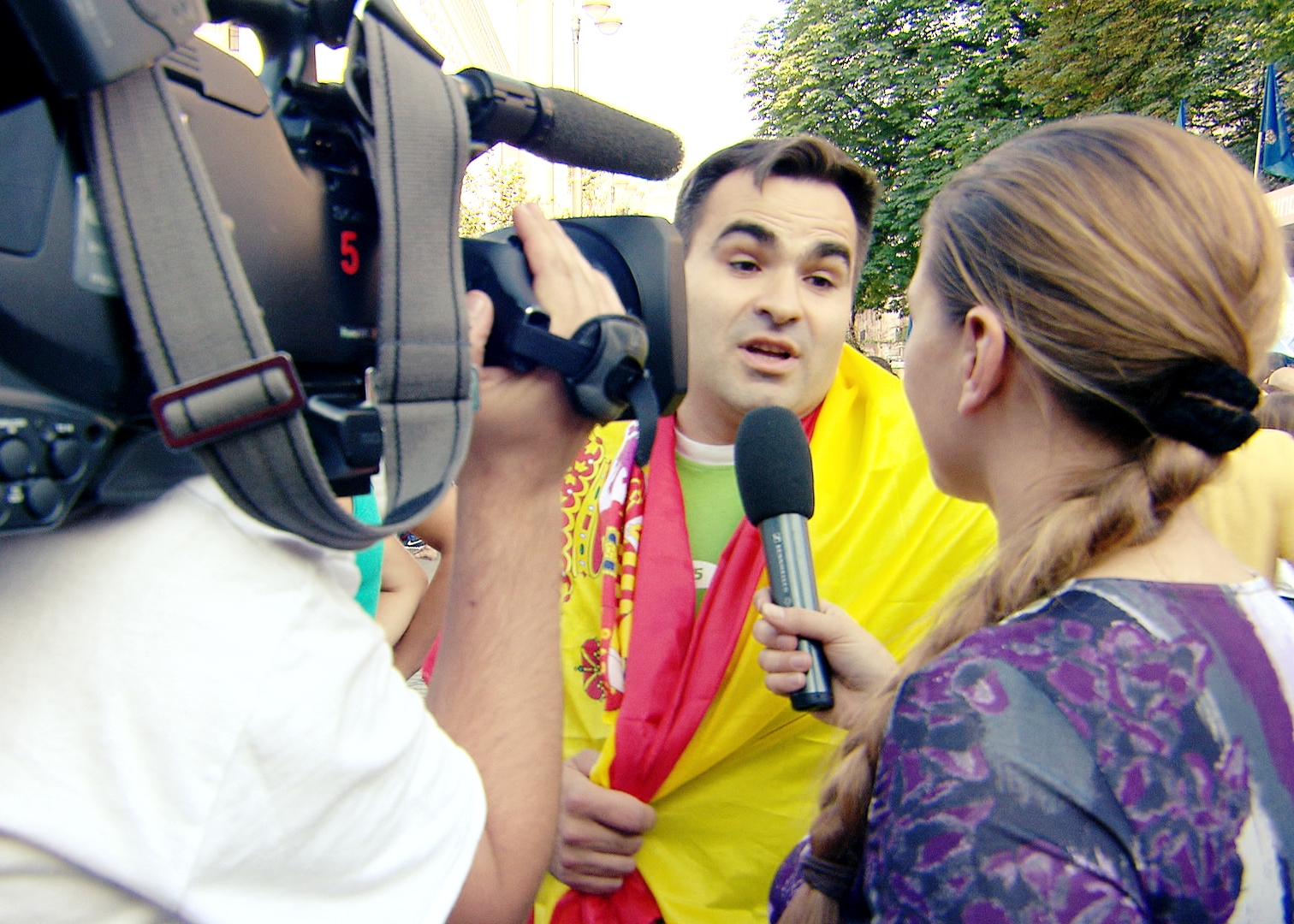
For smaller events, such as the UEFA Youth Tournaments, we deployed a two-person field production team consisting of a camera operator and a field producer. The team travelled to the host country for several days, moving between tournament cities and gathering all the material required for the research videos.
The production included extensive interviews with fans and local residents, together with detailed observational footage of their surroundings, behaviour and interactions. We also captured the stadiums, fan zones and tournament cities, focusing on the organisation, atmosphere and visual aspects of the event. Since the research itself was conducted by the agency, an agency reporter accompanied the production team and led the interviews, ensuring that the conversations addressed the relevant research topics.
After the tournament, the interview footage was delivered to the agency, which selected the statements relevant to the research findings. We then edited these interviews into dynamic, engaging films, building the visual narrative around them with carefully selected cutaways and establishing footage. A single tournament typically resulted in five or six finished insight videos.
For larger tournaments such as the UEFA EURO, the production operation was significantly more extensive. Two field teams, each consisting of a camera operator and field producer, travelled continuously between the host cities throughout the tournament, periodically returning to Poland to deliver the latest material.
This created a parallel post-production operation in Poland. A three-person editing team processed the material while the tournament was still underway, delivering interviews to the agencies and beginning the preparation of the visual footage. This workflow was essential given the scale of the final output: a single project could result in around 50 individual films.
Each film typically went through an average of five versions before reaching its final form, meaning that the post-production team was effectively managing around 250 film versions within a single project. Keeping the material organised, maintaining a consistent visual language and coordinating revisions across such a large volume of content became a major logistical challenge in its own right.
Creatively, each film had to perform two functions simultaneously. It needed to translate the research findings into something tangible, using in-depth interviews and detailed observational footage to give context to the data presented in the accompanying slides. At the same time, the films had to remain dynamic and engaging, with a visual treatment and motion graphics package adapted to the specific visual identity of each UEFA tournament.



Our Creative Approach – Multimedia Presentation
The second part of the project was the multimedia presentation itself. Our responsibility was to design the complete visual system for each presentation and develop the navigation and functionality that connected its different elements. The work was carried out in close collaboration with the research agency, while the design had to follow the visual identity of the respective tournament.
A significant part of the process involved transforming the raw research slides supplied by the agencies into a coherent and visually consistent presentation. The agencies provided the research content and data, while we developed the graphic design, structure and presentation of that information.
The scale was substantial. A multimedia presentation for a tournament such as the UEFA EURO could contain around 50 thematic sections, with approximately 10 slides per section, resulting in around 500 individual slides. With each slide typically going through an average of three versions before final approval, the production process involved approximately 1,500 slide versions.
The presentation was designed as an integrated system rather than simply a collection of slides. Thematic sections allowed users to navigate directly to specific areas of the research, while the corresponding insight videos provided a human and visual dimension to the statistical findings. This connection between data, presentation design and video was central to the entire concept.
The Result
The result of each project was a complete, interactive multimedia research presentation combining hundreds of research findings with a substantial library of original video content.
Instead of working through a conventional report, UEFA could navigate directly to the area of interest, review the relevant research findings and immediately access the corresponding insight video. The data provided the quantitative picture, while the interviews and detailed observational footage added context, perspective and a human dimension to the findings.
Behind this apparently simple user experience was a highly coordinated production and post-production operation involving field crews, editors, designers and the research agencies, often working simultaneously during the tournament itself.
The format was very well received by UEFA, as well as by its sponsors and partners.


